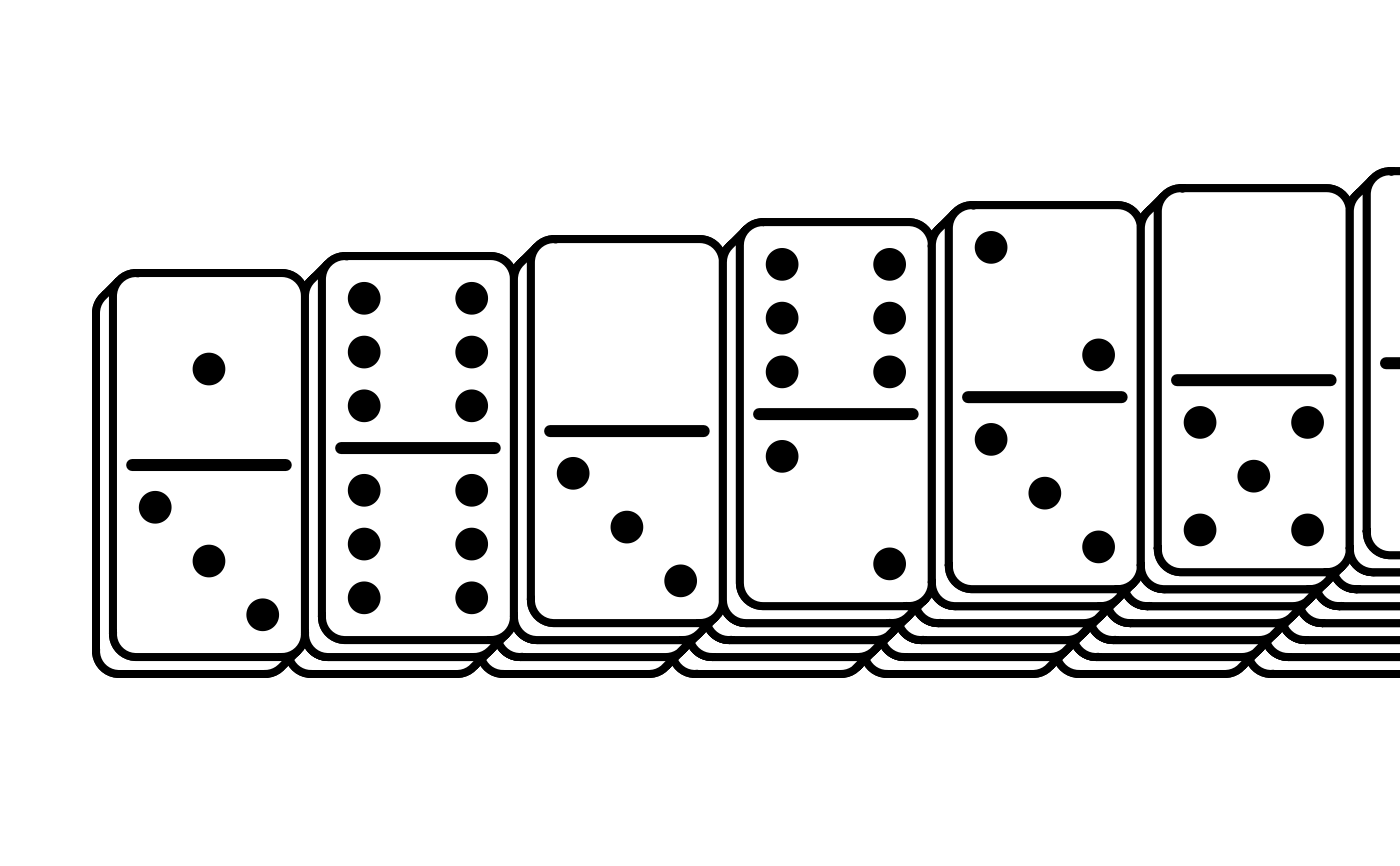
tibble data frames of setups for 10 dominoes variants.
Data frame output can usually be plotted with pmap_piece(df, default.units = "in").
Usage
domino_concentration(seed = NULL)

domino_bee_donimoes(n = 7, seed = NULL)

domino_finder(seed = NULL)

domino_freecell(n = 7, seed = NULL)

domino_fujisan(seed = NULL, ..., pips = NULL, pawns = "S12M/A12C")

domino_luzon(seed = NULL)

domino_patience(seed = NULL)

domino_runners(seed = NULL)

domino_the_jubilee(seed = NULL)

domino_the_sultan(seed = NULL)
Arguments
- seed
Seed that determines setup, either an integer or
NULL- n
The number of doubles in a set e.g.
n = 7for double-6 set,n = 10for a double-9 set,n = 13for a double-12 set.- ...
Should be left empty.
- pips
A vector or matrix of Fuji-san pip layout, or
NULLfor a random layout. Can also be a string of integers with the rows separated by a/. The first row is the top row (y=2) and the second is the bottom row (y=1).- pawns
A FEN-like string of the initial pawn placement. The four pawns
S,M,C, andAare represented by their letter and empty spaces by a number.
Value
A tibble::tibble() data frame with the following columns:
"piece_side"
"suit"
"rank"
"cfg" (optional, defaults to
"piecepack")"x"
"y"
"angle" (optional, defaults to
0).
This data frame is compatible with piecepackr::render_piece() and likely ppcli::cat_piece().
Details
Here are links for more information about the various games:
| Game | URL |
| Bee Donimoes | https://donkirkby.github.io/donimoes/rules.html#bee-donimoes |
| Concentration | http://www.domino-play.com/Games/Concentration.htm |
| Domino Finder | https://donkirkby.github.io/donimoes/rules.html#domino-finder |
| Dominoes Freecell | https://www.pagat.com/invented/domfreecell.html |
| (Domino) Fuji-san | http://donkirkby.github.io/donimoes/rules.html#fujisan |
| Luzon | http://www.domino-play.com/Games/Luzon.htm |
| (Domino) Patience | http://www.domino-play.com/Games/Patience.htm |
| Domino Runners | https://donkirkby.github.io/donimoes/rules.html#domino-runners |
| The Jubilee | http://www.domino-play.com/Games/Jubilee.htm |
| The Sultan | http://www.domino-play.com/Games/Sultan.htm |
Examples
df <- domino_the_jubilee()
if (require("piecepackr", quietly = TRUE) &&
    packageVersion("piecepackr") >= "1.15.0-9") {
  grid::grid.newpage()
  envir = game_systems(round = TRUE)
  pmap_piece(df, envir = envir, default.units = "in",
             trans = op_transform, op_scale = 0.5)
}