
area_boundaries() splits a grid grob into one grob per area it paints with its fill.
Usage
area_boundaries(grob, ...)

# S3 method for class 'gTree'
area_boundaries(
  grob,
  ...,
  leaves = c("polygon", "pathgrob", "rect", "circle", "roundrect", "xspline",
    "GridFillStroke", "GridFill")
)

# S3 method for class 'gList'
area_boundaries(
  grob,
  ...,
  leaves = c("polygon", "pathgrob", "rect", "circle", "roundrect", "xspline",
    "GridFillStroke", "GridFill")
)
Arguments
- grob
A grid grob or a
grid::gList()of grobs (whose areas are those of its grobs in order).- ...
Passed to methods (the builtin methods don't use them).
- leaves
The classes of the (non-
gTree) children of agTreeorgListwhich may have areas.
Value
A grid::gList() of grobs (one per area, empty if grob has none).
Details
area_boundaries() splits a grid grob into one grob per area it paints with its fill:
one per polygon of a
grid::polygonGrob()rectangle of a
grid::rectGrob()path (its rings grouped by
pathId) of agrid::pathGrob()circle of a
grid::circleGrob()(closed) spline of a
grid::xsplineGrob()the (single) rounded rectangle of a
grid::roundrectGrob()filled symbol (
pch21 to 25) of agrid::pointsGrob()(in point order)the (single) path of a
grid::fillStrokeGrob()orgrid::fillGrob()Grobs without such an area (e.g. lines or text) have none nor does a grob which only builds its shapes when drawn (with a
grid::makeContext()orgrid::makeContent()method) until it is forced withgrid::forceGrob()(aswith_pattern()does when drawn ifdelay = TRUE).
The areas are in a fixed order
(which the per-area pattern parameters and pool of with_pattern() follow):
the polygons of a grid::polygonGrob() or grid::xsplineGrob() by increasing id
and the paths of a grid::pathGrob() by increasing pathId
(grid stores these as integers; those given by id.lengths / pathId.lengths are
1, 2, ... in drawing order so sorting keeps that order
while an id such as c(2, 2, 2, 1, 1, 1) puts its second polygon first),
the rectangles of a grid::rectGrob(), circles of a grid::circleGrob(),
and filled symbols of a grid::pointsGrob() in element order,
and all the areas of a child of a gTree (or gList) before those of its next child.
The areas of a gTree (or gList) are those of its children in drawing order:
a child gTree is walked recursively
while any other child only has areas if it inherits from one of the leaves classes.
By default leaves leaves out a grid::pointsGrob()
so e.g. the (filled) outliers of a {ggplot2} boxplot have no areas
unless "points" is added to leaves.
A grob given as grob itself always has its areas
(leaves only selects the children of a gTree or gList).
Another package may add an area_boundaries() method for its own grob class
(and add the class to leaves)
or for its own gTree subclass (whose areas are then those of its method, which is passed leaves,
instead of its children's and which with_pattern() patterns as a whole like layers = "grob").
Each boundary is a grob as.patternGrob() can fill with a pattern
and with_pattern() fills each area of a grob this way.
Each boundary is drawn like its shape of grob:
it keeps its own elements of the graphical parameters (gp) of grob
(e.g. the second boundary of a grid::rectGrob() with gp = gpar(fill = c("red", "blue")) is filled blue)
combined with those of the gTrees it is within
(e.g. a fontsize its "lines" units depend on, while cex, alpha, and lex multiply)
and the viewport (vp) its coordinates are relative to
(the vp of a gTree is pushed before those of its children's boundaries by grid::vpStack())
so a boundary drawn by itself is drawn where its area is.
The childrenvp of a gTree (viewports a child's vp may refer to by a grid::vpPath())
isn't handled.
The rings of a path (grouped by pathId) stay together so an area may have holes
while each polygon of a grid::polygonGrob() is an area even where it overlaps another.
See also
with_pattern() which fills each area of a grob with a pattern
and as.patternGrob() which fills a single boundary grob.
Examples
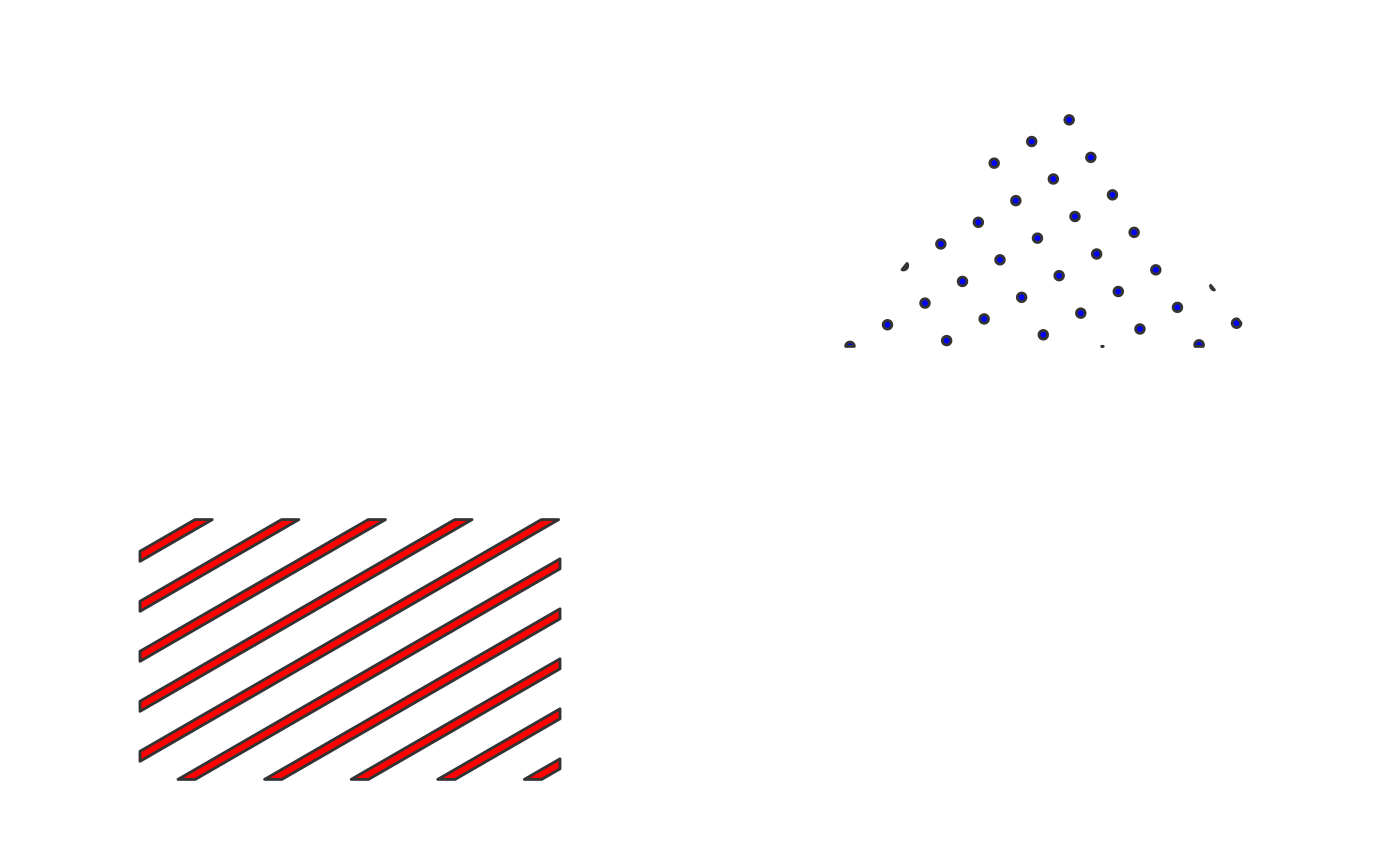
run_example <- require("grid", quietly = TRUE)
if (run_example) {
polygon <- polygonGrob(x = c(0.1, 0.4, 0.4, 0.1, 0.6, 0.9, 0.75),
y = c(0.1, 0.1, 0.4, 0.4, 0.6, 0.6, 0.9),
id.lengths = c(4, 3))
boundaries <- area_boundaries(polygon)
length(boundaries) # 2
grid.newpage()
grid.draw(as.patternGrob(boundaries[[1]], "stripe", fill = "red"))
grid.draw(as.patternGrob(boundaries[[2]], "circle", fill = "blue"))
}
 if (run_example) {
# a gTree's areas are its children's (text has none)
tree <- gTree(children = gList(rectGrob(x = c(0.25, 0.75), width = 0.4, height = 0.4),
textGrob("label")))
length(area_boundaries(tree)) # 2
}
#> [1] 2