
Fill the areas of a grob with the patterns of their rows of aesthetics
Source:R/with-pattern.R
with_pattern_aes.Rdwith_pattern_aes() fills each area of a grob
(e.g. the grob drawn by a {ggplot2} geom's draw method)
with the pattern of its row of a layer's data
and with_pattern_key() fills each area of a legend key glyph with the key's pattern.
They are wrappers around gridpattern::with_pattern() for writing the
draw_panel() / draw_group() and draw_key() methods of a pattern geom
(see vignette("developing-pattern-geoms", package = "ggpattern")).
Usage
with_pattern_aes(grob, data, pool = FALSE, legend = FALSE, delay = FALSE)

with_pattern_key(key, data, size, aspect_ratio = get_aspect_ratio())
Arguments
- grob
A grid grob (usually the grob drawn by the parent
{ggplot2}geom).- data
A data frame of aesthetics with either one row per area of
grob(in the order ofgridpattern::area_boundaries()) (or per unique value ofpool) or a single row used for every area. Forwith_pattern_key()the key's (single row) data.- pool, legend
Passed to
gridpattern::with_pattern().- delay
If
TRUEthe areas ofgrobare only filled when it is drawn: for a grob whose areas only exist then (e.g. one that makes its children in amakeContent()method). ThedotstackGrobofggplot2::geom_dotplot()(whose dots are made when it is drawn) is always filled when it is drawn. Then a wrong number of rows is only an error when the grob is drawn.- key
A grid grob: a
{ggplot2}key glyph e.g. as drawn byggplot2::draw_key_polygon().- size, aspect_ratio
As in
draw_key_polygon_pattern(): the key's width and height (in mm) and the plot's aspect ratio. Callwith_pattern_key()within adraw_key()method (when{ggplot2}draws the legend) so the defaultaspect_ratiois right.
Details
The pattern aesthetics (e.g. pattern and pattern_fill) are the pattern parameters
and the other columns (e.g. fill and colour) are passed on as well
for the (custom) patterns that use them,
except the x and y positions, PANEL,
and the names of the arguments of gridpattern::with_pattern() and gridpattern::patternGrob()
(id, name, gp, vp, boundary, default.units, draw, pool, layers, delay,
leaves, legend, and prefix).
The pattern column is the pattern's name ("stripe" if there isn't one).
See also
make_GeomPattern() to make a pattern geom from a geom without writing its draw methods.
default_pattern_aes() for the default pattern aesthetics.
Examples
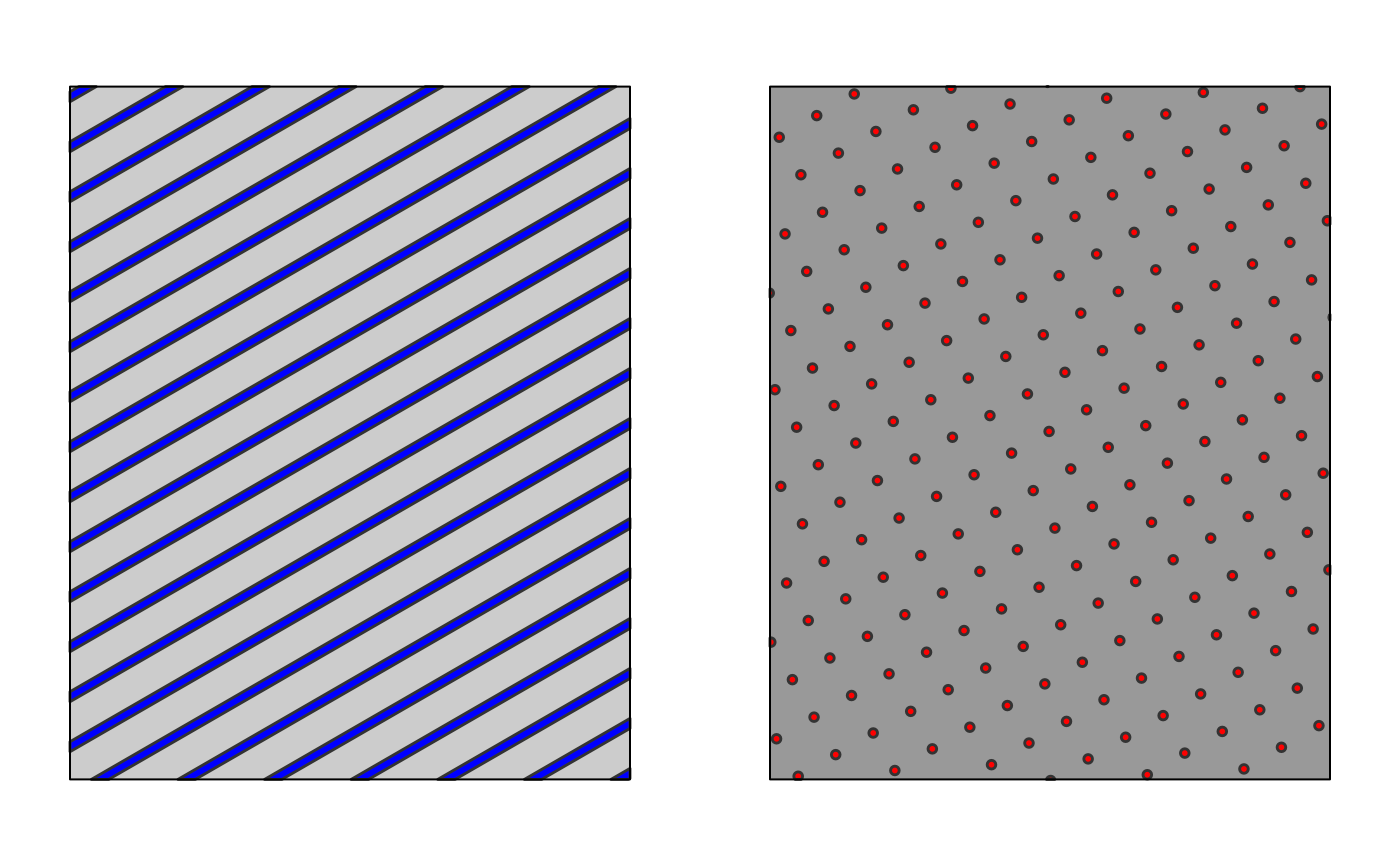
grob <- grid::rectGrob(x = c(0.25, 0.75), width = 0.4, height = 0.8,
gp = grid::gpar(fill = c("grey80", "grey60")))
data <- data.frame(pattern = c("stripe", "circle"), pattern_fill = c("blue", "red"))
grid::grid.newpage()
grid::grid.draw(with_pattern_aes(grob, data))
 # e.g. the `draw_key()` method of a pattern geom
draw_key <- function(data, params, size) {
with_pattern_key(ggplot2::draw_key_polygon(data, params, size), data, size)
}