
Developing Pattern Geoms
Source:vignettes/developing-pattern-geoms.Rmd
developing-pattern-geoms.RmdOverview
ggpattern provides a pattern version of most ggplot2 geoms (e.g. geom_rect_pattern()). For any other geom (from ggplot2 or an extension package) there are three ways to fill its areas with patterns, from the least to the most work:
-
with_pattern()makes a pattern layer from a layer, for a one-off plot. -
make_GeomPattern()makes a pattern geom from a geom, for a reusablegeom_*_pattern()function. - Writing the pattern geom’s draw methods yourself with
with_pattern_aes()andwith_pattern_key(), for full control.
All three draw the parent geom’s grob as usual and then fill each of its areas with the pattern of its row of the layer’s data using gridpattern::with_pattern(). Each area’s fill, pattern, and border are drawn in turn (like ggplot2 draws its areas) so overlapping areas stack as they would without patterns.
To write a new pattern (rather than a new geom) see vignette("developing-patterns", package = "ggpattern").
with_pattern(): a pattern layer from a layer
with_pattern() (re-exported from gridpattern) takes a layer and pattern aesthetics set to constants (in ...) or mapped (in mapping):
ggplot(mtcars, aes(mpg, wt)) +
  geom_point() +
  with_pattern(geom_smooth(method = "lm", formula = y ~ x),
               pattern = "plasma", pattern_alpha = 0.7)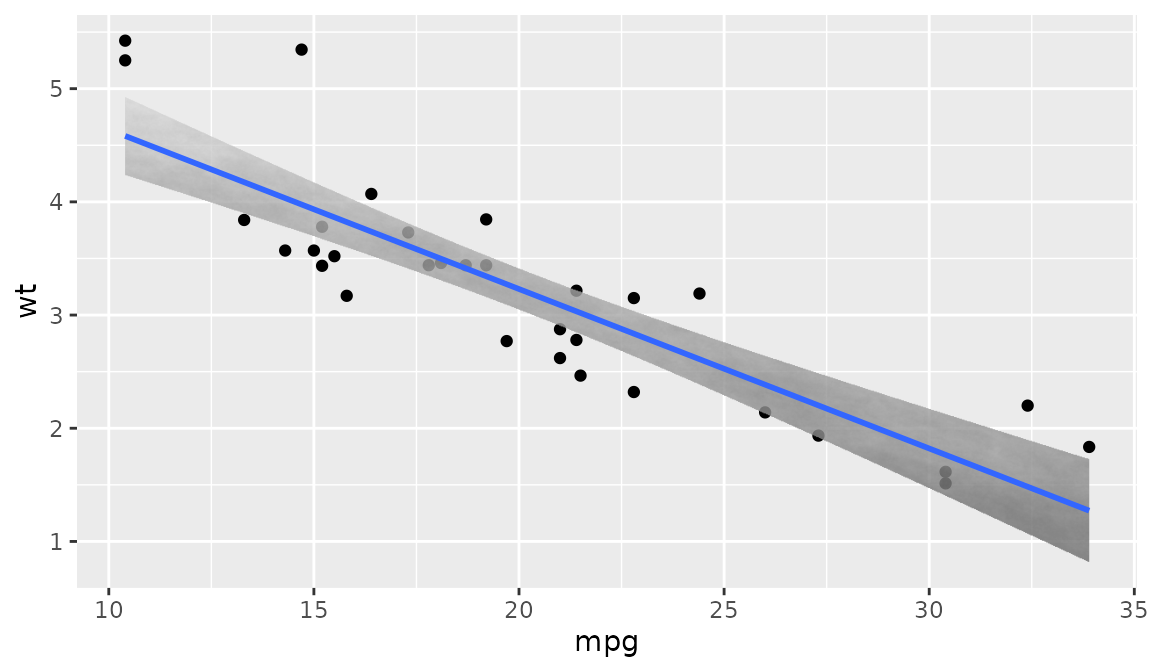
If ggpattern has a pattern geom for the layer’s geom (e.g. GeomRectPattern for geom_rect()) it is used, otherwise the pattern geom is made by make_GeomPattern(). Only the layer’s geom is replaced so it keeps its stat, position, and other parameters.
make_GeomPattern(): a pattern geom from a geom
make_GeomPattern() makes a pattern Geom from a Geom: it has the geom’s aesthetics plus the pattern aesthetics, draws the geom’s grob with its areas filled with patterns, and draws the geom’s legend key glyph filled with the key’s pattern. Use ggplot2::make_constructor() to make its geom_*_pattern() function:
GeomSmoothPattern <- make_GeomPattern(GeomSmooth)
geom_smooth_pattern <- make_constructor(GeomSmoothPattern, stat = "smooth", se = TRUE)

ggplot(mtcars, aes(mpg, wt, colour = factor(am), pattern = factor(am))) +
  geom_point() +
  geom_smooth_pattern(method = "lm", formula = y ~ x,
                      pattern_colour = "grey40", pattern_spacing = 0.03)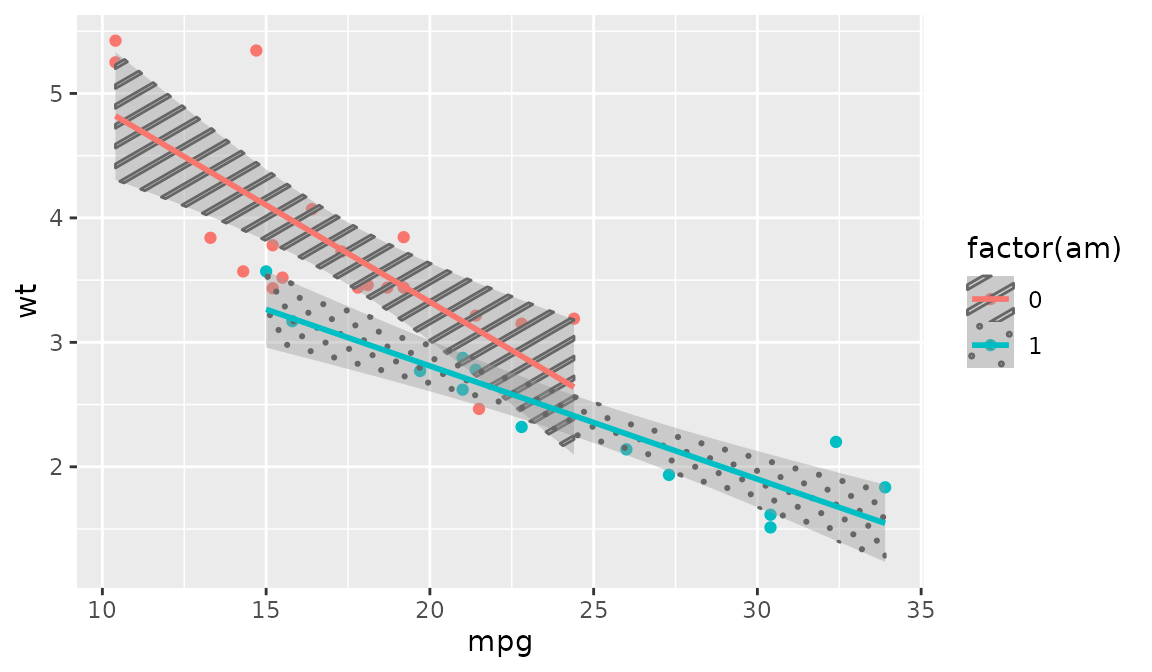
A Geom doesn’t know the default stat and position of its geom_*() function (they are arguments of that function) so pass them to make_constructor() if they aren’t "identity", as with stat = "smooth" above. Likewise a constructor argument’s default is taken from the geom’s draw method which may differ from that of its geom_*() function: GeomSmooth only draws its confidence band (the area to fill) if se = TRUE which is the default of geom_smooth() but not of GeomSmooth$draw_group(), hence se = TRUE above. Without the stat the layer may fail with an error about missing aesthetics the stat would have computed e.g. ggridges::geom_density_ridges() needs stat = "density_ridges" (which computes height) and position = "points_sina":
library("ggridges")
GeomDensityRidgesPattern <- make_GeomPattern(GeomDensityRidges)
geom_density_ridges_pattern <- make_constructor(GeomDensityRidgesPattern,
                                                stat = "density_ridges", position = "points_sina")
Matching areas to rows: area_by
The pattern geom needs to know which row of the data each area of the grob was drawn for. area_by says how:
-
"row": the geom draws an area per row in row order (e.g.GeomRectandGeomHex). -
"group": the geom draws an area per group sorted by group (e.g.GeomPolygon) or itsdraw_group()method draws a single area (e.g.GeomRibbonandGeomViolin). -
"trace": the geom is drawn with a differentfillper row and each area gets the pattern of the row whosefillit was drawn with (and then its actualfillback). This works for most geoms without knowing how they draw their areas (e.g. one that draws its areas in a different order than its rows) but it draws the geom twice and needs it to draw each area with its row’s (character)fill. Areas not drawn with a row’sfill(e.g. decorations) are left alone. - A function of the data frame returning the rows of the areas in drawing order (or a single row for every area). It is also given the draw method’s other parameters (e.g.
lineend) by name if it has an argument of that name (or...), since some geoms’ drawing order depends on them.
By default make_GeomPattern() uses what it knows the ggplot2 geoms need and otherwise "trace", so area_by is mainly for speed or for a geom that tracing can’t handle. If the geom’s grob doesn’t have as many areas as area_by gives rows the error says which geom and area_by and suggests trying area_by = "trace".
A grob that only makes its areas when it is drawn (e.g. in a makeContent() method) is filled when it is drawn.
Using make_GeomPattern() in a package
Code at the top level of a package’s R/ files is run when the package is built, not when it is loaded. So a pattern geom made there by make_GeomPattern() stores a copy of the geom it was made from (its methods, default aesthetics, and draw method arguments) as it was when your package was built. If that geom is from another package (e.g. ggplot2) which is later updated without your package being reinstalled the pattern geom keeps using the old copy: it won’t have any new aesthetics or parameters and its old methods may fail with the updated package. (This doesn’t affect with_pattern() or make_GeomPattern() used in a script or within a function, nor a geom from your own package.)
Either make the pattern geom (and its constructor) when your package is loaded:
GeomSmoothPattern <- NULL
geom_smooth_pattern <- NULL

.onLoad <- function(libname, pkgname) {
  GeomSmoothPattern <<- ggpattern::make_GeomPattern(ggplot2::GeomSmooth)
  geom_smooth_pattern <<- ggplot2::make_constructor(GeomSmoothPattern, stat = "smooth", se = TRUE)
}
or write the pattern geom’s draw methods yourself (see the next section) as ggpattern does for its own geoms: a geom made by ggplot2::ggproto() looks up the geom it extends each time it is used.
Writing a pattern geom’s draw methods
For full control write the pattern geom’s methods yourself:
-
default_pattern_aes()gives the default pattern aesthetics to add to the geom’sdefault_aes. Most areNaN(“unset”) so that each pattern’s own defaults apply: copy them withdefault_pattern_aes()rather than writing your own values. -
with_pattern_aes(grob, data)fills each area ofgrobwith the pattern of its row ofdatawithin adraw_panel()ordraw_group()method. -
with_pattern_key(key, data, size)fills each area of a key glyph with the key’s pattern within adraw_key()method (scaling it so the key’s pattern looks like the plot’s).
For example this is essentially how our GeomHexPattern is written (the draw_group() method of ggplot2::GeomHex draws a hexagon per row, in row order):
GeomHexPattern2 <- ggproto("GeomHexPattern2", GeomHex,
  default_aes = aes(!!!GeomHex$default_aes, !!!default_pattern_aes()),
  draw_group = function(self, data, panel_params, coord, ...) {
    grob <- ggproto_parent(GeomHex, self)$draw_group(data, panel_params, coord, ...)
    with_pattern_aes(grob, data) # one row per hexagon
  },
  draw_key = function(data, params, size) {
    with_pattern_key(draw_key_polygon(data, params, size), data, size)
  }
)

ggplot(diamonds, aes(carat, price)) +
  stat_bin_hex(aes(pattern_fill = after_stat(count) > 1000),
               geom = GeomHexPattern2, bins = 12, pattern_density = 0.3) +
  labs(pattern_fill = "count > 1000")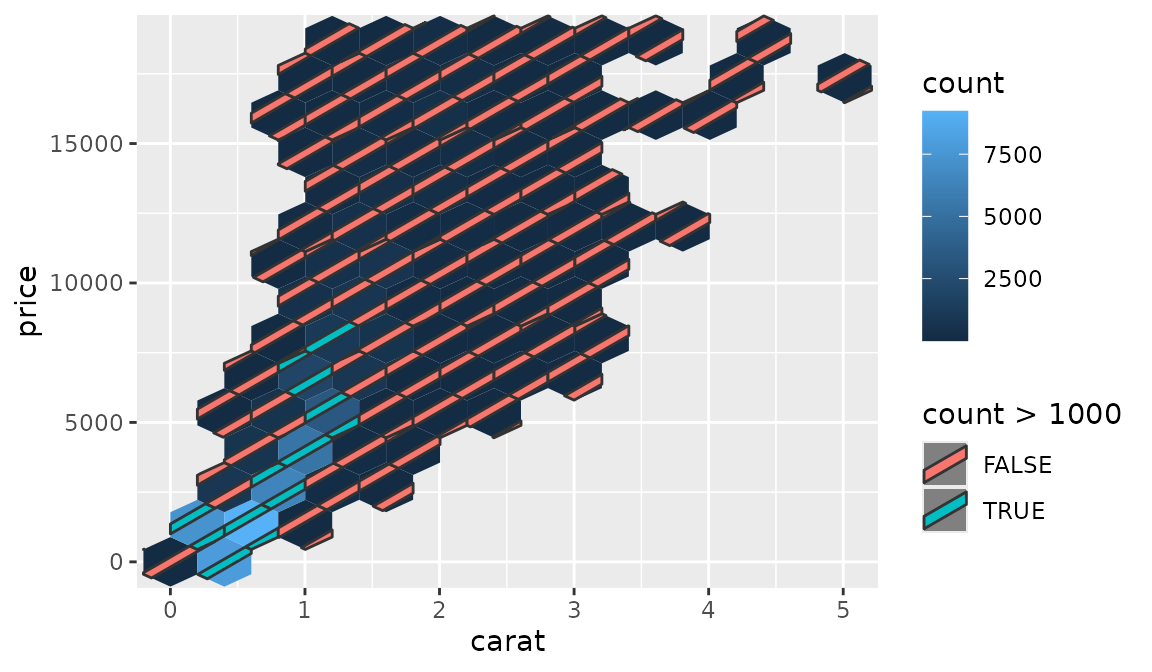
Whatever such a geom copies from the geom it extends (here its default_aes and in general the arguments of a draw method that names them instead of using ...) is only as up to date as your package’s last build so it is worth testing that they still match.
Things to watch out for:
-
Row order.
datamust have a row per area in the order the grob draws them (the order ofgridpattern::area_boundaries(grob)) or a single row for every area. E.g.ggplot2::GeomPolygondraws its groups’ polygons sorted bygroupandggplot2::GeomPointonly has areas for its filled shapes (shape21 to 25). Areas that should be filled as one (e.g. the polygons of aMULTIPOLYGONgeometry) can be given the same value ofpool(with a row per unique value). -
Areas made when drawn. If the grob only makes its areas when it is drawn use
with_pattern_aes(grob, data, delay = TRUE). -
Other columns. Besides the pattern aesthetics the other columns of
data(e.g.fill) are passed on to the pattern (for custom patterns that use them) exceptx,y,PANEL, and the names ofgridpattern::with_pattern()’s own arguments. -
Key size. Call
with_pattern_key()within thedraw_key()method. ggplot2 may enlarge a key whose glyph has no size attributes afterdraw_key()returns so thesizeit is given can be too small (e.g.draw_key_point_pattern()uses the larger ofsizeand the point’s size).
Alternatively subclass one of ggpattern’s pattern geoms (e.g. GeomRectPattern or GeomPolygonPattern) to inherit its default aesthetics, draw methods, and legend key.