Contents
piecepackr comes with built-in configurations for a variety of dice via the game_systems() function.
Traditional six-sided pipped dice
Note
Chinese dominoes were introduced in piecepackr v1.13.
The dice configuration provides standard pipped dice in six colors with the suit controlling the color and the rank controlling the number of pips [1]. The dominoes_chinese and dominoes_chinese_black configurations provide Asian-style dice (and Chinese dominoes). dominoes_chinese has a white background with black and red pips while dominoes_chinese_black has a black background with white and red pips.
library("piecepackr")
envir <- game_systems()
grid.piece("die_face", suit = 1:6, rank = 1:6, cfg = envir$dice,
           x = 1:6, y = 1, default.units = "in", op_scale = 0.5)
grid.piece("die_face", suit = 1:6, rank = 1:6,
           cfg = rep(c("dominoes_chinese", "dominoes_chinese_black"), length.out = 6), envir = envir,
           x = 1:6, y = 2, default.units = "in", op_scale = 0.5)
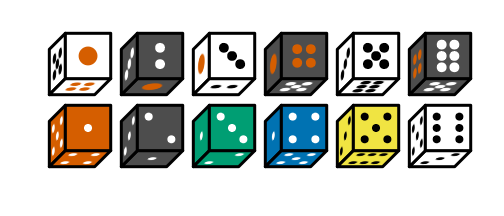
Traditional pipped dice (Western and Asian-style)
| [1] | The die pieces in other configurations such as the various “dominoes” configurations may also contain standard six-sided dice when appropriate. |
Polyhedral dice
Note
The polyhedral dice were introduced in piecepackr v1.13.
The dice_d4, dice_numeral, dice_d8, dice_d10, dice_d10_percentile, dice_d12, and dice_d20 configurations provide the seven polyhedral dice most commonly used by wargames, roleplaying games, and trading card games in six colors controlled by suit.
library("piecepackr")
envir <- game_systems()
grid.piece("die_face", suit = c(1:6, 1), rank = 1:7,
           cfg = paste0("dice_", c("d4", "numeral", "d8", "d10_percentile", "d10", "d12", "d20")),
           envir = envir, x = 1:7, y = 1, default.units = "in", op_scale = 0.5)
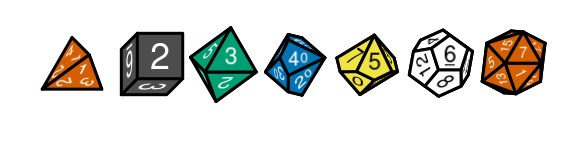
Polyhedral dice
Fudge/Fate dice
Note
The Fudge dice were introduced in piecepackr v1.11.
The dice_fudge configuration use the six-sided Fudge dice with two plus, two minus, and two blank faces most commonly used in the Fudge and Fate roleplaying games.
library("piecepackr")
grid.piece("die_face", suit = 1:6, rank = 1:6, cfg = game_systems()$dice_fudge,
           x = 1:6, y = 1, default.units = "in", op_scale = 0.5)
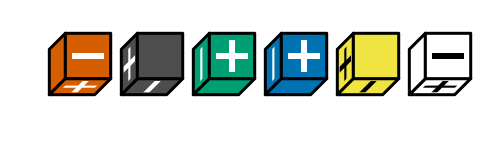
Fudge dice
Piecepack dice
Note
The inverted piecepack was introduced in piecepackr v1.10.
The piecepack, dual_piecepacks_expansion, playing_cards_expansion, and piecepack_inverted configurations provide piecepack dice [2].
library("piecepackr")
envir <- game_systems("dejavu")
cfg <- rep(c("piecepack", "dual_piecepacks_expansion", "playing_cards_expansion", "piecepack_inverted"), each = 4)
grid.piece("die_face", suit = rep(1:4, 4), rank = 2,
           cfg = cfg, envir = envir,
           x = rep(1:4, each = 4), y = rep(1:4, 4),
           default.units = "in", op_scale = 0.5)
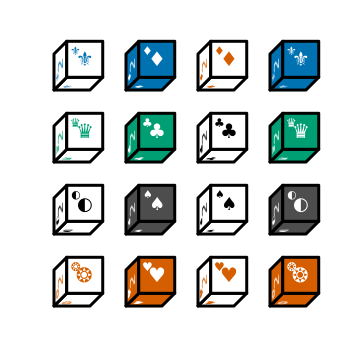
Piecepack dice
| [2] | There are also piecepack dice in the hexpack and subpack configurations but these are just small versions of the piecepack dice. |
Chess dice
Note
The chess1 and chess2 configurations were introduced in piecepackr v1.6.
The chess1 and chess2 configurations provide chess dice.
library("piecepackr")
envir <- game_systems("dejavu")
grid.piece("die_face", suit = 1:6, rank = 1:6,
           cfg = envir$chess1, x = 1:6, y = 1,
           default.units = "in", op_scale = 0.5)
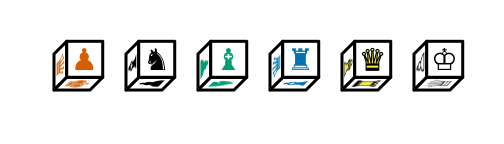
Chess dice
Custom dice
piecepackr allows for custom six-sided dice. One can use configurations and custom grob functions to customize the faces of the dice and use the die_arrangement configuration to customize the ordering, rotation, and size of the faces when visualized in a 3D projection or arranged in a Print & Play layout.